• Great stories don’t begin when the article goes live — they begin when curiosity is sparked. To build anticipation for my upcoming Medium feature, “Iconic Sports Upsets: Why We Love Them & Why They Last,” I created a series of short-form promotional teasers tailored to three major social platforms: LinkedIn, Instagram/Facebook, and X (Twitter).

    Each post is intentionally crafted to match the platform’s audience behavior, content style, and engagement patterns. Together, they form a cohesive, multi-platform strategy designed to generate interest, emotional connection, and meaningful traffic to the full article.

    LinkedIn Promotion – Professional Storytelling & Cultural Impact
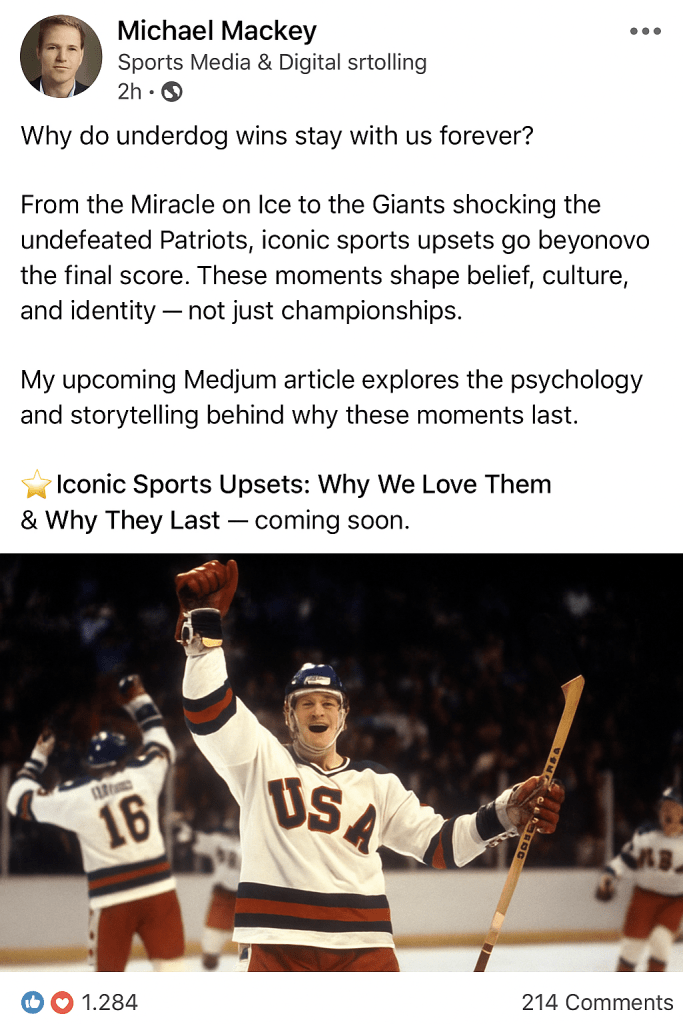
    LinkedIn Post

    Why do underdog wins stay with us forever?

    From the Miracle on Ice to the Giants shocking the undefeated Patriots, iconic sports upsets go far beyond the final score. These moments shape belief, culture, and identity, not just championships.

    My upcoming Medium article explores the psychology and storytelling behind why these moments last.
    “Iconic Sports Upsets: Why We Love Them & Why They Last” — coming soon.

    LinkedIn rewards reflective, insight-driven content, making it the ideal platform for positioning this article through a cultural and psychological lens rather than as simple sports commentary. This post targets professionals in media, communications, sports business, and storytelling. The imagery focuses on universally respected historic moments, reinforcing credibility and significance.

    Instagram / Facebook Promotion – Emotion, Memory, and Visual Impact

    Instagram / Facebook Post

    We all remember where we were when it happened.

    The shot.
    The catch.
    The win no one saw coming.

    Why do sports upsets stay with us forever? My new Medium article breaks down the emotion, psychology, and magic behind the moments that made us believe.

    “Iconic Sports Upsets: Why We Love Them & Why They Last” — coming soon.

    Instagram and Facebook thrive on emotion, relatability, and visual storytelling. The short, dramatic phrasing mirrors how fans recall these moments emotionally rather than analytically. The images focus on crowd reactions and celebration, which heighten nostalgia, shock, and joy for a broad audience of casual sports fans and students.

    X (Twitter) – Fast Hook & Conversation Starter
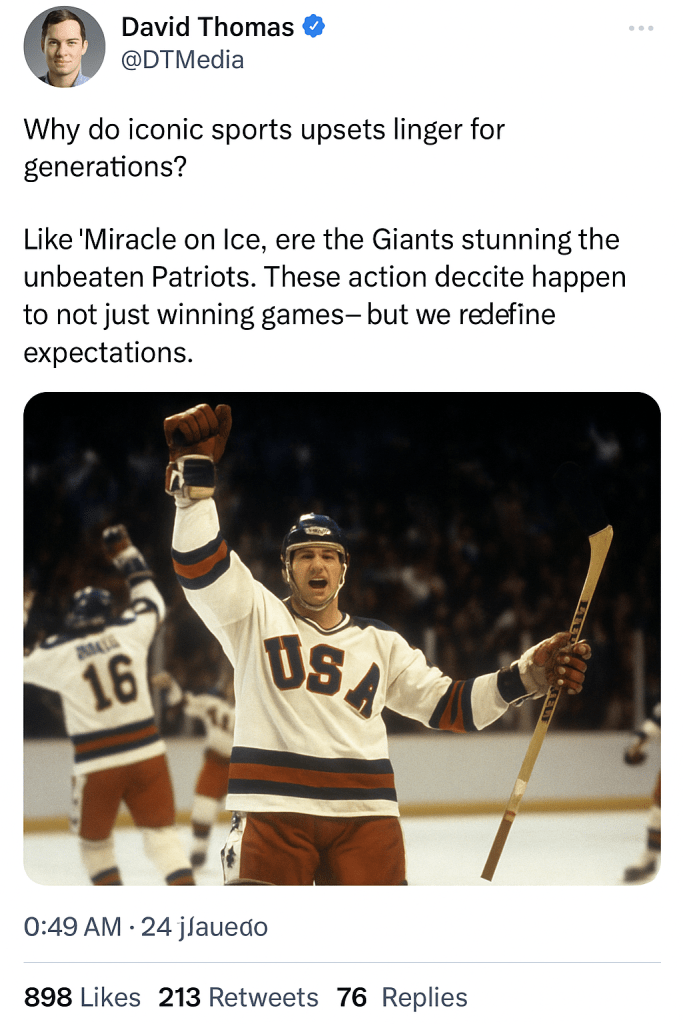
    X / Threads Post

    The best sports moments aren’t always about the best teams.

    They’re about the impossible wins we never forget.

    My upcoming Medium article explores why underdog upsets stay in our memory forever.
    “Iconic Sports Upsets: Why We Love Them & Why They Last” — coming soon.

    X and Threads prioritize speed, bold perspective, and real-time conversation, so this teaser is intentionally short and declarative. The scoreboard and action-shot visuals reinforce urgency and drama while targeting sports media followers, commentators, and real-time fan communities.

    Final Perspective

    Each platform plays a distinct role in shaping visibility:

    • LinkedIn builds credibility and thought leadership
    • Instagram/Facebook deliver emotional connection
    • X/Threads create momentum and conversation

    Together, these teasers form a coordinated promotional strategy that increases reach, strengthens brand identity, and directs readers toward the full Medium article. Rather than duplicating the same message across every platform, this approach demonstrates how intentional, platform-specific storytelling drives stronger engagement and more meaningful audience connection.


  • Why Finding Your Real Voice Matters More Than Ever
    The current image has no alternative text. The file name is: image-6.png

    Every week in this course, I’m reminded that writing is less about sounding impressive and more about sounding like yourself. After reading Zinsser’s chapters on clutter, simplicity, and voice. Plus the material from Modules 3 and 4, one theme kept coming back to me is how we live in a world filled with noise, and the only way to stand out is to be honest.

    Zinsser argues that readers simply know when you’re faking it. Whether you’re trying too hard to sound academic, stuffing sentences with unnecessary filler words, or slipping into a “breezy” tone that talks down to people. 

    He reminds us that the result is always the same: the writing doesn’t feel real. And when it doesn’t feel real, it doesn’t allow the reader to connect or fully engage. 

    That idea hit home for me because so much of what I write, emails, presentations, class assignments, even LinkedIn posts, comes with pressure. Pressure to sound perfect. Pressure to sound smart. Pressure to sound like someone who “fits” in the business world, in order to get a job and be successful. But Zinsser basically calls that out. He says we lose our voice when we write for approval instead of communication.

    The part that stuck with me most was when he said your voice should be something readers recognize across all topics. You can’t switch personalities or your writing styles because the subject changes. 

    You have to speak in the same clear, honest voice for all topics. Whether you’re writing about sports, business, or your personal story, your voice must stay the same!

    It made me rethink the way I write professionally. I’ve always tried to come across a certain way, I call it, “business polished.” But the truth is, the most engaging writing is usually the one that sounds the most human.

    I saw this in our other readings too. Audience matters, but not in the “change who you are” way. Audience matters because you have to respect your reader. Their time, intelligence, and their attention. That means being clear, being direct, and saying something real. It also means avoiding clichés, filler words, and the meaningless phrases we all fall back on when we’re not confident in what we want to say. 

    If there’s one takeaway from these chapters, it’s this, good writing isn’t about decoration, it’s about truth. And truth only shows up when your voice does.

    Going forward, that’s the standard I want to hold myself to. Less clutter, less trying to sound like everyone else. More honesty, clarity, and confidence in the way I naturally write. Because if Zinsser is right (and I think he is), your real voice is the only one people will remember.

  • Different Platforms, Different Voices: How Context Shapes Digital Writing

    By: ChatGPT

    The current image has no alternative text. The file name is: the-image-should-visually-represent-various-digital-platforms-like-linkedin.png

    Writing styles vary significantly across digital platforms. Each platform influences tone, structure, and language according to its design, audience, and purpose. LinkedIn generally supports formal, business-oriented communication. Instagram encourages casual and visual storytelling. Twitter focuses on brief statements or reactions due to character limits. The same individual can produce messages that sound entirely different depending on the setting. These variations illustrate the concept that writing is not static; it adjusts to fit context and audience.

    Gary Vaynerchuk summarized this idea through the phrase, “Content is king, but context is God.” This statement highlights that the effectiveness of writing is determined not only by its quality but by its appropriateness for the environment where it appears. A professional-style paragraph would appear out of place on a casual platform like Instagram, just as a highly informal caption might seem unprofessional on LinkedIn. Writers who recognize these distinctions can adapt content to meet user expectations more effectively.

    This principle extends beyond social media. In academic and professional communication, tone, format, and structure also shift depending on the objective. A research paper requires evidence and precision, while a business report prioritizes clarity and conciseness. Context determines not only the writer’s voice but also the reader’s interpretation of meaning.

    William Zinsser’s On Writing Well supports this idea through his concept of unity, which emphasizes maintaining consistent tone, tense, and perspective. According to Zinsser, readers expect coherence throughout a piece. Inconsistencies reduce credibility and disrupt comprehension. Applying unity across digital platforms means adjusting for each environment while ensuring the writer’s core message remains recognizable.

    Kayla Carmicheal’s discussion of long-form writing further develops this relationship between clarity and structure. She explains that long-form content succeeds when paragraphs are organized, ideas are separated by clear headers, and transitions are logical. Formatting decisions such as paragraph length and visual breaks improve readability and retention. Well-structured writing aligns with how online audiences consume information—through scanning and selective reading rather than continuous focus.

    Collectively, these perspectives demonstrate that strong writing requires both content quality and contextual awareness. Writers who understand audience behavior and platform characteristics can communicate with greater efficiency and accuracy. While the message may remain constant, the method of delivery must change depending on where and how it is presented. In digital spaces, context is the defining factor that transforms isolated content into effective communication.

  • From LinkedIn to Twitter: How Context Makes Writing Human

    By: Michael Mackey

    The current image has no alternative text. The file name is: make-me-an-image-with-differnt-styles-of-clothing-someone-1.png

    This week’s readings helped me notice something strange about the way I write depending on where I am online. On LinkedIn, I sound polished and professional. On Instagram, I’m casual, funny and most of all, myself. On Twitter, I’m not writing at all, and if I am, it’s just short casual sentences in the comment section of a post. The platforms on which I’m writing on matter.

    It’s still me in all those places, but in different tones. Each depending on how much I care about being pursued by others. Almost like changing outfits for different occasions. For example, Linkedin, like an interview online, I’m dressed professionally, look sharp and polished. Whereas, Twitter isn’t really getting a good look at my outfit.

    This is when I realized what Gary Vaynerchuk meant when he said, “Content is king, but context is God.” It’s not enough to create good content, it has to make sense for the space it lives in. A business style post on Instagram would feel forced, and emojis would look out of place on LinkedIn. 

    Vaynerchuk’s idea of respecting the “psychology of the platform” reminded me a lot of William Zinsser’s advice in On Writing Well. Zinsser says that good writing depends on unity, keeping the tone, tense, and voice consistent from the beginning of the reading to the end. Whether you’re writing an interactive and engaging post or a for class essay, readers can sense when your voice feels scattered, insincere or awkward.

    One thing all these readings have shown is that context and unity both come down to awareness. When I wrote my first “article” in undergrad, I was focused on sounding “smart.” I used long sentences and formal words, thinking it would impress my readers, and in turn, get a good grade. But instead, my writing felt stiff.  When I loosened up, kept paragraphs short, and added personal stories, the writing finally sounded like me. When the writing became fun to me, it would become and fun for the reader. Kayla Carmicheal’s article on long-form content echoed that point. She emphasized that strong writing keeps a conversational tone and connects with readers through clarity, not complexity.

    This week’s readings taught me that writing isn’t just about just choosing the right words, it’s about meeting readers where they are. Every platform, differences in audience, and moment calls for its own, different kind of voice. When writers respect that, they create something more than content, they create connection with the reader.

  • Writing for Me, but Keeping You Awake
    The current image has no alternative text. The file name is: image-3.png

    This week’s reading from On Writing Well by William Zinsser really made me stop and think. Zinsser says two things that sound like they totally clash in chapter 5. Which really stood out for the remainder of the reading. 

    First, he warns us not to lose our readers, as the majority of them are impatient and will drift off if we get sloppy or boring. But then he says we should write for ourselves and not for the reader.

    At first, I thought that made no sense. I felt as though it was contradictory advice, because how can you focus on the reader and yourself at the same time? But after reading it again, I think he’s talking about two different parts of writing.

    The first part is the craft, this is how we build sentences and choose the words we do. This is where the reader comes in. He explained how we need to write clearly all while staying organized, and cutting out the extra filler words that are unnecessary for the reader. If someone stops reading because a sentence is confusing or full of “big” filler words, that’s our fault. This is where the we (the writers) come into play. 

    The second part is voice, what we write about and how we sound to the reader. This is for us, the writer. If we try too hard to guess what the “audience” wants, our writing starts to feel fake. Zinsser basically says: if you’re honest and having fun writing it, the right readers will enjoy it too. 

    Authentic writing will attract authentic readers who will genuinely enjoy what your writing about. If your passionate about it, the reader is going to be more likey to be engaged in the reading and most likely passionate at the end. 

    This idea reminds me of Jakob Nielsen’s article, How Users Read on the Web. He found that people don’t read every word, instead, they scan. So if we want them to keep reading, we have to make our writing clear, short, and real. Both Zinsser and Nielsen agree: people want truth and clarity, not fancy fluff.

    My biggest takeaway after reading chapters 3-7 is to write in a way that sounds like me, but make sure you (the reader) don’t get bored. If I care about what I’m saying and say it simply, chances are, you’ll care too.

  • From Ice to Insight: How a Hockey Player Found His Passion in Sports Journalism
    The current image has no alternative text. The file name is: create-an-image-with-a-computer-sports-broadcaasting-camera-and.png

    Michael Mackey is a 25-year-old from Westchester, New York, and is currently a graduate student at Quinnipiac University pursuing his master’s in Sports Journalism and Media. After receiving his undergraduate degree in Sports Management at West Virginia University, he quickly realized that his true passion was not just managing sports, but telling their stories.

    Since Michael was five years old, he has passionately pursued playing hockey. This dedication continued into his undergraduate years, where he played club hockey for West Virginia University. His whole life, all he ever wanted was to be a hockey player. When that dream began to feel out of reach, he knew he still wanted a career centered around sports.

    Although Michael is passionate about playing hockey, college basketball has always been his favorite sport to watch. There’s something about the energy of March Madness—the rivalries, the unity among teammates, the underdog stories, and the electric atmosphere—that draws him in every season. He loves the way teams come together to become unstoppable forces, the precision behind every play, and the emotional highs and lows that make college basketball so unique.

    He knows that the career for him would involve sports writing or producing sports media. His main goal is to one day work for ESPN and become a writer covering college basketball. He’s also fascinated by the behind-the-scenes side of production and storytelling in sports media.

    Michael decided to take Writing Interactive Media because he believes it’s a great opportunity to refine his writing skills and develop new ones that will help him reach the next chapter of his career journey. 

    He loves writing because he feels it’s the purest form of self-expression—there’s nothing stopping a person from typing out their thoughts and emotions. He believes this class will be critical in learning the key components that will take his writing to the next level.

  • Slow Reading in a Fast Scrolling World 

    The Power of Clear, Simple, and Human Writing.

    The current image has no alternative text. The file name is: create-an-image-of-a-computer-screen-but-make-the.png

    This week was my first time creating and posting a blog for class, and honestly, it felt both intimidating yet exciting. I’ve always written essays for professors, not public readers, making this something I’ve never done before. All of a sudden, I had to think about design, structure, and how someone scrolling online might actually experience my words. Not only does it have to sound semi-professional, but it has to be eye-catching. 

    Reading On Writing Well by William Zinsser helped me start in the right place. The text reminded me that good writing is simpler than it looks. Good writing is clear, simple, and human. I found myself deleting unnecessary filler words and rewriting shorter sentences that sounded like something I’d actually say out loud.

    Then I started reading from both Jakob Nielsen’s “How Users Read on the Web” and Sue Dunlevie’s “16 Rules of Blog Writing.”  Where they completely changed how I now view online content. They made me realize that people don’t read every word online, they skim and scan the context looking only for what they want to know. Which means short paragraphs, strong headings, and white space are very important in any online post. Which I then tried to apply in this post.

    Maria Konnikova and Nicholas Carr showed me why our brains struggle to read deeply online. Here, I realized I skim too. Carr’s question, “Is Google making us stupid?” stuck with me, because sometimes I do feel more distracted than informed. I move too fast and my attention to detail when it comes to reading information on the internet isn’t good. . 

    Steven Pinker’s idea of the “curse of knowledge” also sat with me. In his reading “The source of Bad Writing” he explained that writers forget that readers don’t know a lot, that there’s a reason they are researching it in the first place. This reminded me to write with clarity. Effective communication doesn’t come from texts that sound the smartest. You want the audience to actually understand what you are saying, not feel dumb when they are reading it.  

    Overall, this first assignment taught me that writing online isn’t just about what you say, it’s about how you say it and guide your reader through it. I’m still learning, but I already see how structure can make a huge difference when it comes to audience engagement and interpretation.